Adrenal fatigue affects individuals who suffer from physical, mental, environmental, or emotional stress for more than three months. Adrenal fatigue can affect anyone, but more likely single parents, individuals who are drug-dependent, those who have faced a life crisis or trauma, or those who have a stressful job circumstance. The term “adrenal fatigue syndrome” encompasses a broad spectrum of debilitating symptoms associated with chronic adaptation to stress. Nervousness, body aches, sleep disturbance, digestive problems, reduced memory, and feelings of tiredness and exhaustion are some of the common adrenal fatigue symptoms.[1]
 Does Adrenal Fatigue Really Exist?
Prolonged exposure to stress leads to degenerative and physiological changes that are brought up by the excessive stimulation of the sympathetic nervous system in our bodies. As of now, no specific medical condition can diagnose this progression to health degeneration.
Science demonstrates that stress affects adrenal-gland activities and hormonal or glucocorticoid secretion via the hypothalamus-pituitary-adrenal (HPA) axis, supporting the theory of the adrenal fatigue syndrome.[2] Whether or not the diagnosis exists, simple options are available to help with the collection of symptoms. A personalized and holistic plan that includes counselling, medications, herbs, supplements, and lifestyle changes can help to support the body’s adaptation to stress. In herbal medicine, plants that support the adaptation to stress are called “adaptogens.”
Then, What Is the Real Theory Behind Adrenal Fatigue?
Adrenal fatigue occurs when the body’s attempt to withstand chronic stress fails to respond appropriately to that stress. Adrenal glands are two small organs that are located above our kidneys; they are responsible for secreting the release of our stress hormones like cortisol and adrenaline.[3] With long-term stress, or maladaptive coping mechanism, the adrenal glands may release less stress-related hormones because of a negative feedback loop associated with hormone production via the HPA axis. Symptoms of adrenal fatigue occur because of such conditions.[4][5] Physiological progression of adrenal fatigue consists of three phases: the alarm, the resistance, and the exhaustion phases.[6]
During the alarm phase, also known as the fight-or-flight response, the body responds to the release of stress hormones by increasing blood pressure, heart rate, and blood flow to muscles. During the resistance phase, the action of cortisol is most prevalent. Anti-inflammatory when secreted in small amounts, cortisol suppresses the immune system when there is too much and increases the risk of disease. Diminished amounts of cortisol and aldosterone during this phase cause a decrease in gluconeogenesis, rapid blood-sugar fall, sodium loss, and potassium retention.[6]
 Adrenal Fatigue Versus Adrenal Insufficiency
Adrenal insufficiency is a medical condition that occurs when our adrenal glands do not produce enough hormones, due to damage in the adrenal or the pituitary glands.[7][8] The pituitary gland is a pea-sized gland present in the brain; its primary function is to instruct the adrenal glands to produce cortisol.[9] A person who has adrenal insufficiency can be confused as well as dehydrated and experience severe weight loss. They can feel tired, weak, and dizzy; and have blood pressure abnormalities.
Other symptoms include nausea, diarrhea, stomach pain, and vomiting. Adrenal fatigue is not as severe, nor is it a medical condition, and it is characterized by high stress levels that affect the optimal functioning of the adrenal glands.
Symptoms and Signs of Adrenal Fatigue
The most common symptoms and signs of adrenal fatigue are the following:[10][11][12]
- decreased energy and stamina—feeling exhausted and run-down most of the day
- reduced resilience
- decreased productivity
- feeling overwhelmed
- lack of a refreshed feeling, even after eight hours of sleep
- hypoglycaemia
- mild depression
- concentration problems
- craving sugar and salt
- digestive problems
- trouble in waking up and getting to sleep
- tiredness
- lightheadedness when standing up quickly
- inability to really wake until after 10 a.m., afternoon low between 3 and 4 p.m., and then feeling better after 6 p.m.
- increased effort to do everyday tasks.
Natural Treatment of Adrenal Fatigue
Lifestyle Modification
There are some modifications that you can bring into your lifestyle for reducing the effects of adrenal fatigue:[13][14]
- Identify your biggest stressors, and what have been your usual coping mechanisms.
- Increase your free time up to two hours per day, away from screens and portable telephones.
- Practice mindfulness and deep breathing.
- Practice moderate daily exercise.
- Have a regular sleep schedule.
- Create a chart! After prioritizing the items, start doing more of the things that make you feel good and try to reduce the things that are making you feel low or stressed out.
- Avoid people or situations that drain your energy or reduce the amount of time with them.
- Eat meals at around the same time every day.
Dietary Changes: Foods to Avoid
It is recommended to limit the use of drinks and foods which are high in sugar.[15] Here are some foods which should be consumed in moderation or avoided:
- white flour
- white sugar
- caffeine
- alcohol
- soda
- processed food
- fried foods
- artificial sweeteners
- fast foods
Foods to Eat
Prefer foods that have healthy fats, a balanced amount of protein, and nutrient-dense carbohydrates. Increase fruits and vegetables to at least five servings per day. Here is a list of foods you should include in your diet to help cope with adrenal fatigue:[16]
- fish
- eggs
- nuts
- legumes
- colourful vegetables
- leafy greens
- whole grains
- olive oil
- grapeseed oil
- coconut oil
- low-sugar fruits
Nutraceuticals
Vitamins B and C as well as magnesium are also good for the optimal functionality of the adrenal glands. Vitamin C, which is essential in the production of adrenal steroid hormones and used in the adrenal cascade, is a crucial vitamin for adrenal recovery.
Herbal Supplements
Here are some adaptogenic botanicals that enhance the “state of non-specific resistance” in stress,[17][18] to help you with the collection of the symptoms.
Licorice Root
Licorice (Glycyrrhiza glabra) root has shown benefits for those in the exhaustion phase of adrenal fatigue. Studies demonstrate that licorice functions to regulate cortisol levels and improve energy.[19][20] Deglycyrrhizinated licorice may be preferable for people with high blood pressure.
Siberian Ginseng
Siberian ginseng (Eleutherococcus senticosus) is an herb that supports the adrenal glands and increases body stamina. It also helps to improve memory, chronic fatigue, irregularities in blood sugar levels, and lowered immunity. It is one of the best natural treatments for adrenal fatigue.[21][22]
 Golden Root
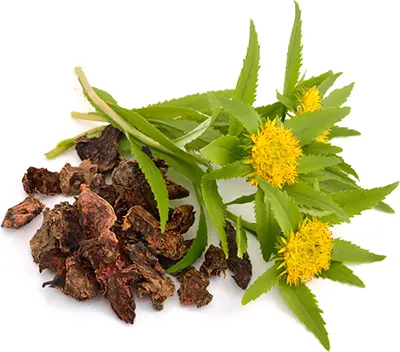
Golden root is also known as Rhodiola rosea. If you are suffering from adrenal fatigue, then this root can help improve energy and mood.[23][24]
Maca Root
Maca contains vitamins B and C, zinc, magnesium, calcium, and iron. Maca is a good source of phytonutrients, antioxidants, and plant-based proteins. It helps to relieve depression and anxiety as well as to support mood balance and energy.[25][26]
Outlook
If you feel symptoms such as weakness, feelings of tiredness, or exhaustion, then you should visit your naturopathic doctor for your full diagnosis. You may also have anemia, sleep apnea, depression, fibromyalgia, or other health-related problems, so it is advised, if you suffer from multiple health concerns, to visit a naturopathic doctor.
 Dr. Farnoush Khodarahmi, MSc, MA, ND
A naturopathic doctor from North York in Ontario, her passion in life is to guide her patients as they grow on their journey to their optimal health and wellbeing, inspiring others around them to do the same for themselves.
ndmedic.com
References
- Lee, D. “Adrenal fatigue syndrome: A project report” (master’s thesis, California State University, 2009), https://bit.ly/3iy87la.
- Spiga, F., E. Zavala, J.J. Walker, Z. Zhao, J.R. Terry, and S.L. Lightman. “Dynamic responses of the adrenal steroidogenic regulatory network.” Proceedings of the National Academy of Sciences, Vol. 114, No. 31 (2017): E6466–E6474.
- Rosol, T.J., J.T. Yarrington, J. Latendresse, and C.C. Capen. “Adrenal gland: Structure, function, and mechanisms of toxicity.” Toxicologic Pathology, Vol. 29, No. 1 (2001): 41–48.
- Hajare, R.A. “90 90 90 Formulas and Symptoms of Adrenal Fatigue Syndrome (AFS) of Adult Men.” Orthopedics and Sports Medicine: Open Access Journal, Vol. 1, No. 3 (2018): 42–45.
- Jameson, D. “Persistent burnout theory of chronic fatigue syndrome.” Neuroscience and Medicine, Vol. 7, No. 2 (2016): 66–73.
- Martini, F.H. Fundamentals of Anatomy and Physiology, 6th Edition. San Francisco: Pearson Education, 2004.
- Oelkers, W. “Adrenal insufficiency.” New England Journal of Medicine, Vol. 335, No. 16 (1996): 1206–1212.
- Charmandari, E., N.C. Nicolaides, and G.P. Chrousos. “Adrenal insufficiency.” Lancet, Vol. 383, No. 9935 (2014): 2152–2167.
- Rubin, R.T., J.J. Phillips, J.T. McCracken, and T.F. Sadow. “Adrenal gland volume in major depression: Relationship to basal and stimulated pituitary-adrenal cortical axis function.” Biological Psychiatry, Vol. 40, No. 2 (1996): 89–97.
- Patel, L., J.K. Wales, M.S. Kiribige, A.A. Massarano, J.M. Couriel, and P.E. Clayton. “Symptomatic adrenal insufficiency during inhaled corticosteroid treatment.” Archives of Disease in Childhood, Vol. 85, No. 4 (2001): 330–334.
- McDermott, M.T. “Adrenal Fatigue.” In Management of Patients with Pseudo-Endocrine Disorders, edited by M.T. McDermott, 127–137. Cham: Springer, 2019
- Lee, D. “Adrenal fatigue syndrome: A project report” (master’s thesis, California State University, 2009), https://bit.ly/3iy87la.
- Cope, C.L. Adrenal steroids and disease, 2nd Edition. London: Pitman Medical, 1972.
- Wilson, J.L. “A clinical perspective on stress, cortisol, and adrenal fatigue.” Advances in Integrative Medicine, Vol. 1, No. 2 (2014): 93–96.
- Fitzgerald, K. “Health regimen for a 29-year-old female diagnosed with adrenal fatigue.” Integrative Medicine: A Clinician’s Journal, Vol. 10, No. 6 (2011): 36–42.
- Sarris, J., S. Moylan, D.A. Camfield, M.P. Pase, D. Mischouclon, M. Berk, F.N. Jacka, and I. Schweitzer. “Complementary medicine, exercise, meditation, diet, and lifestyle modification for anxiety disorders: A review of current evidence.” Evidence-Based Complementary and Alternative Medicine, Vol. 2012 (2012): 809653.
- Head, H.A., and G.S. Kelly. “Nutrients and botanicals for treatment of stress: Adrenal fatigue, neurotransmitter imbalance, anxiety, and restless sleep.” Alternative Medicine Review, Vol. 14, No. 2 (2009): 114–140.
- Panossian, A., and G. Wikman. “Effects of adaptogens on the central nervous system and the molecular mechanisms associated with their stress—Protective activity.” Pharmaceuticals (Basel), Vol. 3, No. 1 (2010): 188–224.
- Al-Dujaili, E.A., C.J. Kenyon, M.R. Nicol, and J.I. Mason. “Liquorice and glycyrrhetinic acid increase DHEA and deoxycorticosterone levels in vivo and in vitro by inhibiting adrenal SULT2A1 activity.” Molecular and Cellular Endocrinology, Vol. 336, No. 1–2 (2011): 102–109.
- Lim, T.K. “Glycyrrhiza glabra.” In Edible Medicinal and Non-Medicinal Plants, Volume 10: Modified Stems, Roots, Bulbs, T.K. Lim, 354–457. Dordrecht: Springer, 2016.
- [No authors listed.] “Eleuthero.” MedlinePlus, https://medlineplus.gov/druginfo/natural/985.html, last reviewed 2020-05-28.
- Panossian, A., T. Efferth, A.N. Shikov, O.N. Pozharitskaya, K. Kuchta, P.K. Mukherjee, S. Banerjee, et al. “Evolution of the adaptogenic concept from traditional use to medical systems: Pharmacology of stress‐ and aging‐related diseases.” Medicinal Research Reviews, Vol. 41, No. 1 (2021): 630–703.
- Tao, H., X. Wu, J. Cao, Y. Peng, A. Wang, J. Pei, J. Xiao, et al. “Rhodiola species: A comprehensive review of traditional use, phytochemistry, pharmacology, toxicity, and clinical study.” Medicinal Research Review, Vol. 39, No. 5 (2019): 1779–1850.
- [No authors listed.] “Rhodiola.” NIH National Center for Complementary and Integrative Health, https://www.nccih.nih.gov/health/rhodiola, last updated 2020-10.
- Gonzales, G.F. “Ethnobiology and ethnopharmacology of Lepidium meyenii (Maca), a plant from the Peruvian highlands.” Evidence-Based Complementary and Alternative Medicine, Vol. 2012 (2012): 193496.
- Meissner, H.O., P. Mrozikiewicz, T. Bobkiewicz-Kozlowska, A. Mscisz, B. Kedzia, A. Lowicka, H. Reich-Bilinska, et al. “Hormone-balancing effect of pre-gelatinized organic maca (Lepidium peruvianum Chacon): (I) Biochemical and pharmacodynamic study on maca using clinical laboratory model on ovariectomized rats.” International Journal of Biomedical Science, Vol. 2, No. 3 (2006): 260.


 English