Thinning hair and hair loss are no fun for either sex, and they are common in both. In fact, here are a few statistics that we hope won’t scare the hair right out of your roots:[1]
- Male-pattern baldness (androgenic alopecia) is responsible for about 95% of hair loss in men
- About two-thirds of men will experience some hair loss by age 35
- About half of women start losing their hair by age 50
- Thirty-nine percent (29%) of women with hair loss have two key symptoms of depression
- People can begin to lose their hair as young as 15 or 16 years old
Now that we have your attention, let’s first dive into the life of a hair; then we’ll look at why hair loss and thinning hair happen, and what you can do about it.
Why Is My Hair Thinning or Falling Out?
Genetics plays a significant role in whether you will experience thinning hair and hair loss. Check out everyone at your next family gathering! Numerous other factors also play a role, including the following:
- Use of harsh hair products—such as dyes, sprays, relaxers, perms, and gels—can damage your hair.
- Low intake of proteins, vitamins especially B9 and biotin, iron, and other minerals like silica can contribute to hair loss.
- Some hair styles can cause thinning hair, such as tight braids and buns.
- Conversely, excessive levels of vitamins A and E and selenium can cause hair thinning and loss. However, selenium in right quantities supports a healthy thyroid gland, which in turn promotes healthy hair.
Chronic or uncontrolled acute stress can elevate stress hormone levels and have a negative impact on hair growth. In a study, researchers found that a stress hormone in mice (corticosterone) interfered with stem cells required for hair growth in these animals.[2] In humans, the equivalent hormone is cortisol.
Health conditions such as immune-system deficiencies, autoimmune-disease treatments, losing more than 20 pounds quickly, recently giving birth, hormonal fluctuations (e.g., menopause, pregnancy), high fever, skin infections, eating disorders, and stopping birth-control medication can all contribute to thinning hair or hair loss.
However, none of this means you can’t hold onto your hair, reduce hair loss and thinning, and even restore some of your lost locks.
Natural Supplements
Various nutraceuticals have been shown to be beneficial for thinning hair and loss, especially in case of nutritional deficiencies which are often mentioned. Researchers note, however, that among people who don’t have specific nutritional deficiencies, “supplementation may actually prove harmful to hair,” and that “over-supplementation of certain nutrients, including selenium, vitamins A and E, has actually been linked to hair loss.”[3] That’s why it’s important to follow the directions on the bottle when it comes to supplementation, and in this case to promoting hair growth and retention.
Both women and men can take on the challenge of thinning hair by turning to natural products. Hereafters are candidates that you may consider:
- Silica: A nutrient that is the third most abundant trace mineral in the body.[4] A study of 50 women given 10 mg orthosilicic acid per day for 20 weeks found increased hair-shaft thickness and improved strength, including elasticity and break load.[5]
- Biotin: Biotin is a water-soluble essential nutrient associated with the B-vitamin family. It has been used for decades for improving the health of hair, as well as skin and nails.[6]
- Saw Palmetto: It is an herb that may prevent testosterone from breaking down, which can help prevent hair loss.
- Pumpkin Seed Oil: It could block testosterone from transforming into dihydrotestosterone (DHT), a hormone associated with hair loss. Research shows that men who took pumpkin seed oil daily for six months saw a 40% increase in hair count![7]
- Evening Primrose: It is a rich source of linolenic acid (LA) and gamma-linolenic acid (GLA), which may help with hair growth.
- Grapeseed Oil: This is another option to include easily in your cooking or supplementation as it is a source of linolenic acid, vitamin E, and flavonoids which help with hair growth.
- Flaxseed: Either freshly grounded or in the form of oil, it is a natural source of vitamin E and omega-3s, which promote hair growth.
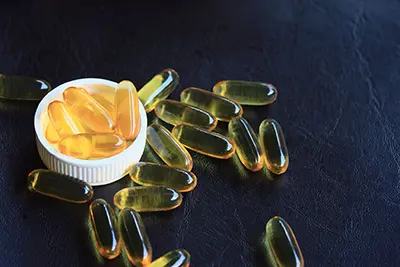 Fish Oil (Omega-3s): These fatty acids are some of the most-researched anti-inflammatory agents, important to consider as inflammation can be an underlying contributor to hair loss.
- Green Tea: This classic and subtle tea delivers high amounts of catechins (especially EGCG) that help lower levels of DHT and thus prevent shrinking of hair follicles.
- Folate/Folic Acid: Also known as vitamin B9, it helps with new-cell generation. Folic acid is believed to help hair follicles produce new hair.
- Vitamin D: Low levels may be associated with female pattern baldness, according to some studies.[8]
These natural nutrients and herbs have been shown to help support hair health in both men and women. For the best quality, visit a health-food store in your community. Specialty stores tend to carry a better selection of natural supplements and vitamins, and offer reputable hair-and-scalp–support formulas. Developed using proven ingredients in studied concentrations, they work synergistically to provide you with healthier, stronger hair. Don’t let thinning hair and hair loss get you down.
 Andrea Donsky, RHN
Andrea Donsky is a registered holistic nutritionist and founder of NaturallySavvy.com—a multiple award-winning website. She has 21 years of experience in the health and wellness space, and is a multiple award-winning influencer. Her newest venture, wearemorphus.com, helps women in perimenopause and menopause. Follow Andrea on TikTok and Instagram @andreadonsky.
naturallysavvy.com
[1] Kuadli, J. “24 Hair loss statistics & facts for a more confident 2021.” Modern Gentlemen, January 3, 2021. · https://moderngentlemen.net/hair-loss-statistics/
[2] Akst, J. “High stress hormone levels halt mouse fur growth.” The Scientist, April 1, 2021. · https://www.the-scientist.com/news-opinion/high-stress-hormone-levels-halt-mouse-fur-growth-68631
[3] Thistlethwaite, J. “Ask a GP: Do vitamins for hair, skin and nails really work?” Body+Soul, August 3, 2017. · https://www.bodyandsoul.com.au/lifestyle/beauty/ask-a-gp-do-vitamins-for-hair-skin-and-nails-really-work/news-story/6deafe76308805f4efb8c989a6e612b6
[4] Jurkić, L.M., I. Cepanec, S. Kraljević Pavelić, and K. Pavelić. “Biological and therapeutic effects of ortho-silicic acid and some ortho-silicic acid-releasing compounds: New perspectives for therapy.” Nutrition & Metabolism, Vol. 10, No. 1 (2013): 2.
[5] Wickett, R.R., E. Kossmann, A. Barel, N. Demeester, P. Clarys, D. Vanden Berghe, and M. Calomme. “Effect of oral intake of choline-stabilized orthosilicic acid on hair tensile strength and morphology in women with fine hair.” Archives for Dermatological Research, Vol. 299, No. 10 (2007): 499–505.
[6] Pawlowski, A., and W. Kostanecki. “Effect of biotin on hair roots and sebum excretion in women with diffuse alopecia.” Polish Medical Journal, Vol. 5, No. 2 (1966): 447–452.
[7] [Hims Editorial Team]. “Pumpkin seed oil for hair growth: Is it effective?” Hims, July 28, 2021. · https://www.forhims.com/blog/pumpkin-seed-oil-hair-growth
[8] Banihashemi, M., Y. Nahidi, N.T. Meibodi, L. Jarahi, and M. Dolatkhah. “Serum vitamin D3 level in patients with female pattern hair loss.” International Journal of Trichology, Vol. 8, No. 3 (2016): 116–120.

 English